
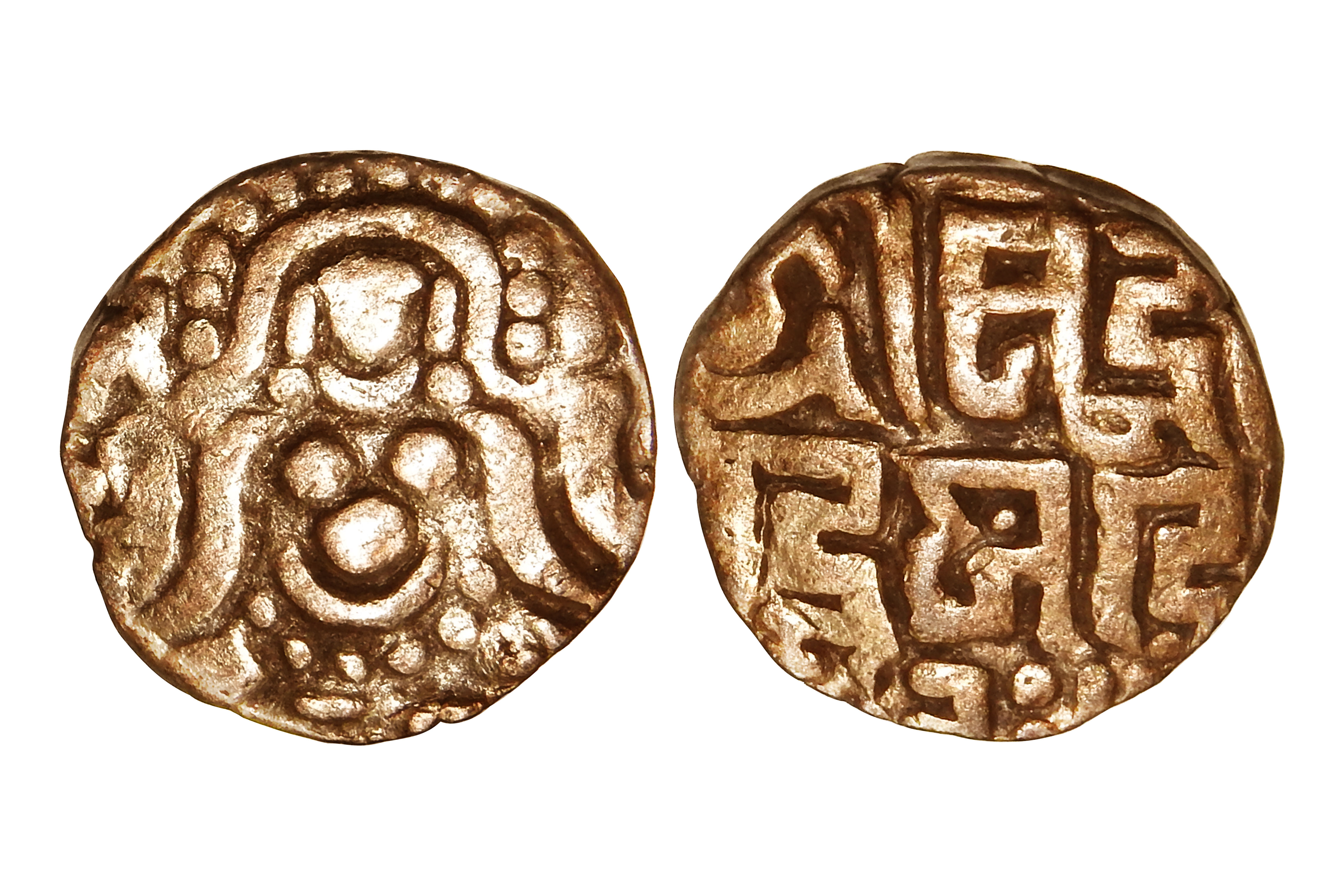
Lot No : 70
Auction No : 8
Kalachuris of Tripuri, Gangeyadeva (1015-1040 AD), Base Gold Dinar, 4 1/2 Masha, 3.80grms, obv. Seated goddess Lakshmi in pamasana with a decorated hairstyle, rev. legend in Devnagari Srimad Gangeyyadva (Deyell 119). Very Fine+, Scarce. Gangeyadeva was the most powerful Kalachuri ruler of Tripuri, aggressively expanding across central and northern India. He fought the Chandellas of Jejakabhukti, pushing into Bundelkhand, and clashed with the Paramaras of Malwa, temporarily occupying Ujjain. His campaigns brought him into conflict with the Chaulukyas (Solankis) of Gujarat and the Eastern Chalukyas. Gangeyadeva assumed the imperial title Vikramaditya, signaling supremacy after military successes, though many gains were contested and short-lived.
16000
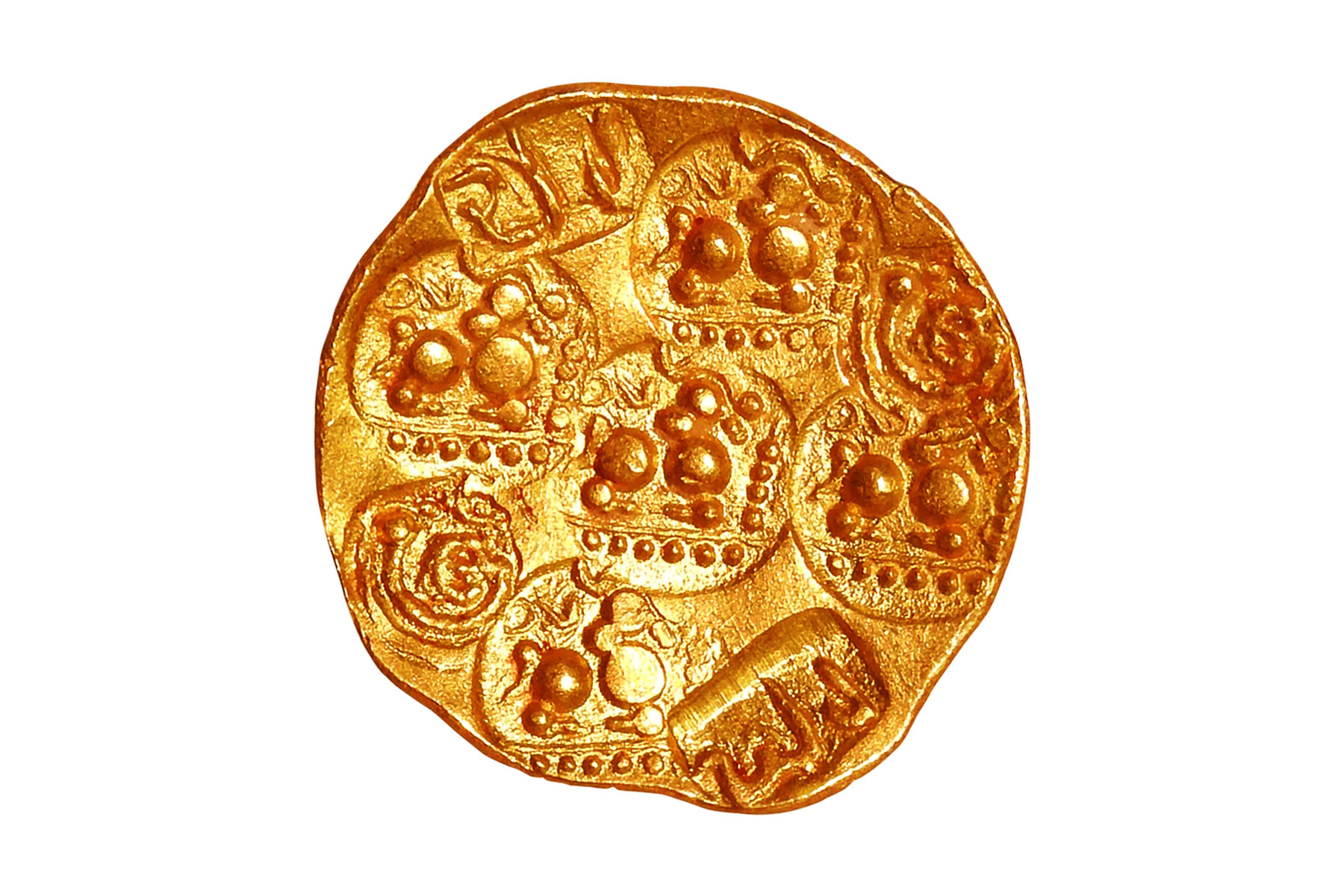
Lot No : 71
Auction No : 8
Hoysala Dynasty, Veera Ballala II, (c. 1173-1220CE), Gold Gadyana, 3.80grms, 9 Punches, 5x Nandi Bull Facing right with Sun & Moon on Back, 2x Shri, 1x Kannada legend Vi Ra, 1x Kannada legend Ba La, bold and deep punches, Exceptional Quality, First recorded specimen- Nolamba Style, Exceedengly Rare and Historically important. A remarkable and previously unrecorded coin bearing the legend “Ve Ra- Ba-La” appears to represent an early issue of Veera Ballala II, struck upon the traditional Nolamba fabric following the Hoysala conquest of Nolambavadi in the late 12th century. The type closely mirrors established Nolamba prototypes in module and style, suggesting a transitional issue produced immediately after Hoysala military absorption of the region. Rather than introducing a new design, Ballala may have retained the familiar local format while asserting authority through the abbreviated royal legend. The coin stands as tangible evidence of political transition — a rare numismatic bridge between Nolamba regional rule and emerging Hoysala imperial control. A historically compelling and potentially groundbreaking attribution. Veera Ballala II greatly expanded the Hoysala Empire, pushing its northern frontier up to the Tungabhadra and Krishna rivers. In Hoysala records dating around 1196 CE, Ballala II claims to have been victorious over several regional powers, including the Nolambavadi territory — the traditional lands of the Nolamba dynasty — along with Banavasi, Hangal, Halashi, Bagalkot, and Yelburga. This indicates that the Hoysalas had militarily asserted control over Nolambavadi, effectively bringing former Nolamba domains into Hoysala dominion during his conquests. Archaeological evidence further supports this transition: a Hoysala inscription of Veera Ballala II found at Hemavati (ancient Henjeru), the former capital of the Nolamba Pallavas, records royal donations to a temple there in 1206 CE, suggesting not just conquest but also administrative and religious influence in the region following its incorporation. In short, Ballala II’s military expansion absorbed Nolambavadi into the Hoysala realm, and epigraphic records show he exercised authority there after conquest.
220000
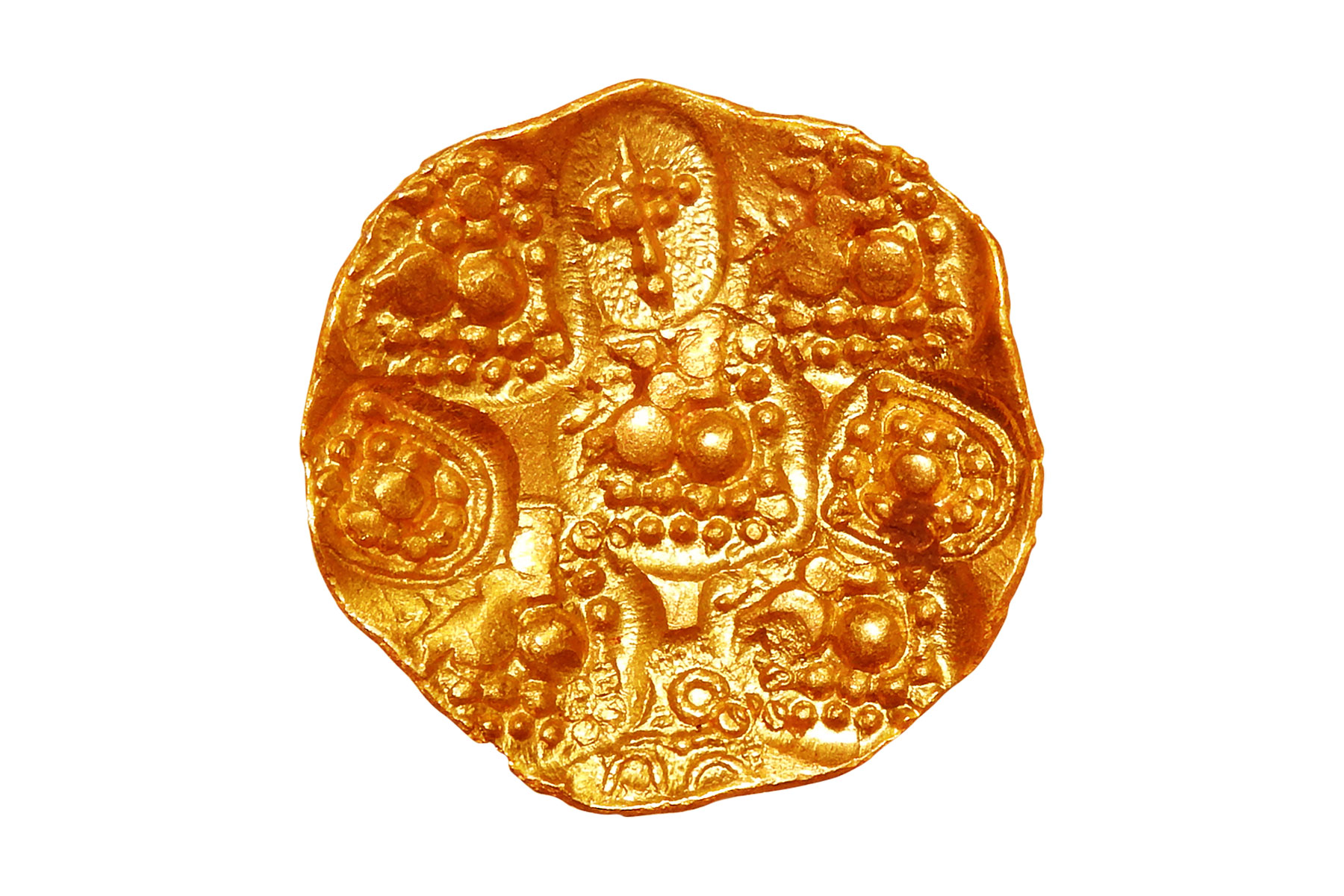
Lot No : 72
Auction No : 8
Nolamba Dynasty, Ekavakya Deva II(c. 981-1000CE), Gold Gadyana, 3.80grms, 9 Punches, 5x Nandi Bull Facing right with Sun & Moon on Back, 2x Shri, 1x Kannada legend Vi Ra, 1x Kannada legend, 1x Elephant Goad with battle axe, 1x Kannada legend GI GI LA, Thin flan, Uniface and deep strike, Rare Ekavakya Deva II was one of the later rulers of the Nolamba dynasty, governing the region known as Nolambavadi in present-day Karnataka during a politically volatile period. His reign occurred when the Nolambas were under increasing military pressure from the rising Western Chalukyas of Kalyani and the imperial Cholas. By this time, Nolamba authority was defensive and regionally concentrated, making surviving gold issues from his rule historically significant. The repeated Nandi bull symbolizes Shaivite devotion, reflecting the dynasty’s strong association with Lord Shiva. The Sun and Moon represent eternal sovereignty — a common South Indian royal emblem signifying rule “as long as the sun and moon endure.” The Shri punches denote auspiciousness and divine legitimacy. The elephant goad (ankusha) and battle axe signify royal authority, martial strength, and the ruler’s duty to discipline and protect his realm. This coin thus embodies Nolamba religious identity, royal symbolism, and political assertion during the dynasty’s final phase of independent power.
90000
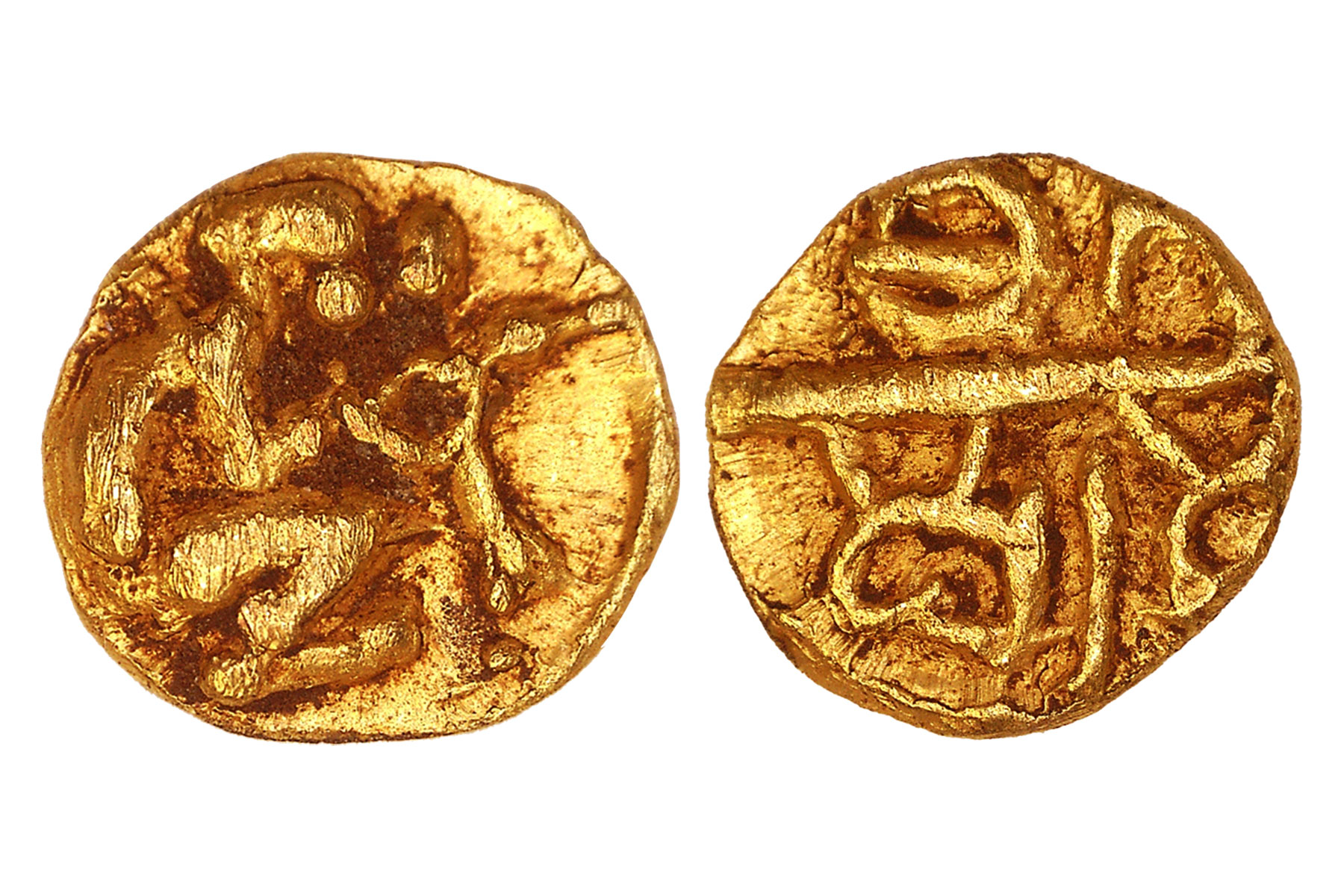
Lot No : 73
Auction No : 8
Early Medieval Karnataka, Hoysala Period(c. 11th–14th century CE), Gold Fanam, 0.40grms, Obv. Maruthi/ Hanuman seated on his tail in Anjali Mudra posture, Rev. Kannada Legend Shri I Sa/ Pu Ra, Extra Fine+, Very Rare. The village of Isavoor in present-day Shikarapur Taluk, Shivamogga district, lies within a historically significant belt of early medieval Karnataka that came under the influence of the Western Chalukyas (10th–12th century CE) and later the Hoysalas (12th–14th century CE). This region formed part of an important inland corridor linking the Malnad and Maidan zones, facilitating both agrarian expansion and temple patronage. Shrines such as the Isapura (Īśvara) temple likely emerged within this broader pattern of Shaivite devotional growth, when temple institutions functioned not only as religious centers but also as focal points of land grants, local administration, and regional identity.
41000
Lot No : 74
Auction No : 8
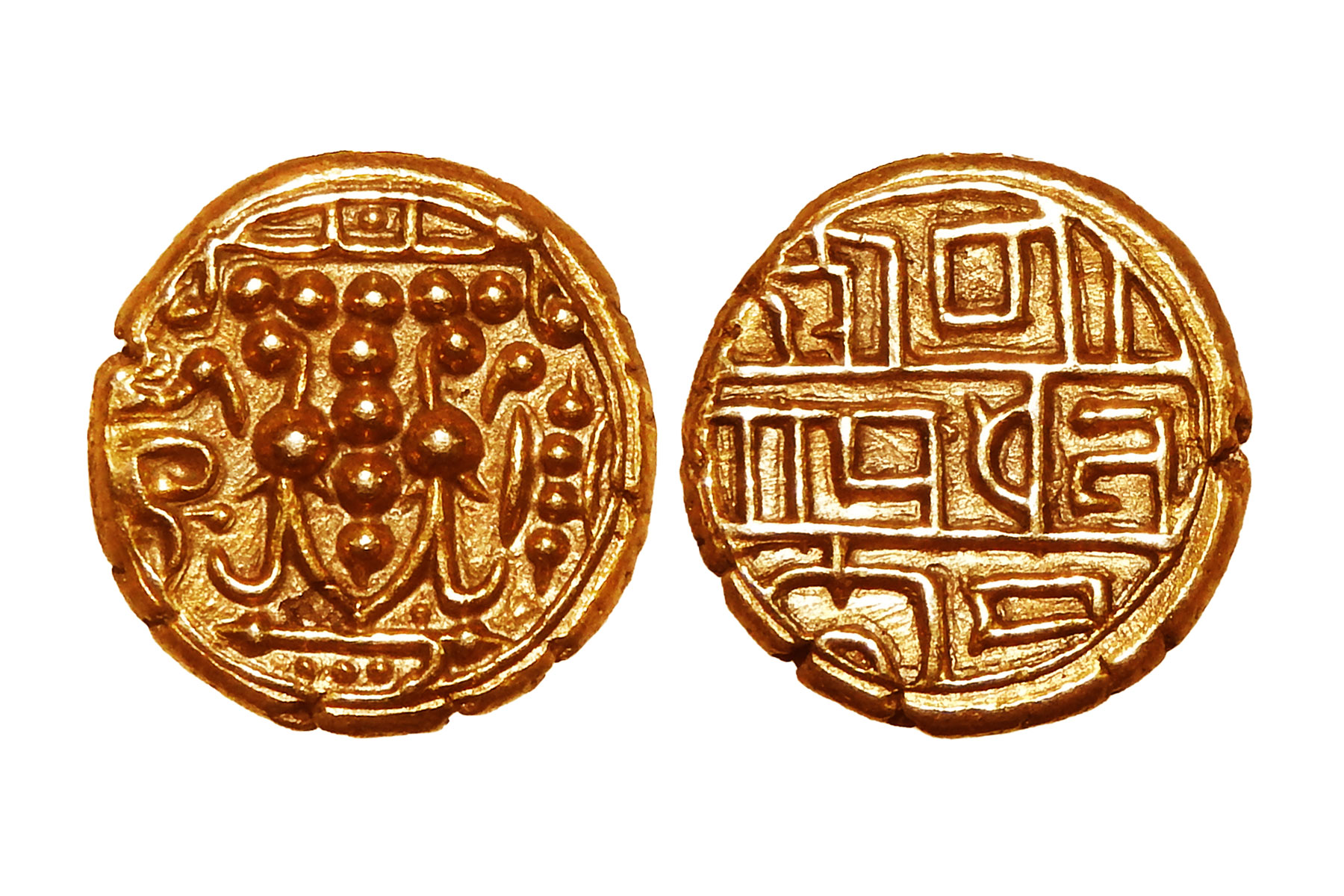
Alupas of Udupi, Kulaśékhara-II(c. 1321-1346), Gold Gadyana, 3.60grms, Obv. Royal Emblem-Mīna Lanchana comprising two highly stylized vertical fishes, positioned above the elephant goad (Ankuśa) and beneath the royal Umbrella. A stylized Conch (Śaṅkha) appears to the left, with a serpent-coiled Hand-Drum (Damaru) to the right. The entire design is enclosed within a circular border, Rev. Legend “Śrī Pā/ndya Dhanam/jaya” in 14th-century squarish Nāgari script, arranged in separated lines. Enclosed within a circular border, Prabhu#52, About Uncirculated, Base Gold issue, Very Rare The Alupa dynasty ruled the coastal Tulunadu region, including modern Udupi, from the 3rd to the 14th century CE, often balancing independence with vassalage under the Kadambas, Chalukyas, and Pandyas. Kulaśékhara II, a late 14th-century ruler, governed during the dynasty’s twilight, consolidating authority over Udupi while navigating pressures from stronger neighbors. His reign reflects the final assertion of Alupa sovereignty, marked by strategic diplomacy, regional administration, and patronage of temples and religious institutions. Under Kulaśékhara II, the dynasty maintained local identity and cultural prominence until eventual absorption into larger powers such as the Vijayanagara Empire.
120000
Lot No : 75
Auction No : 8
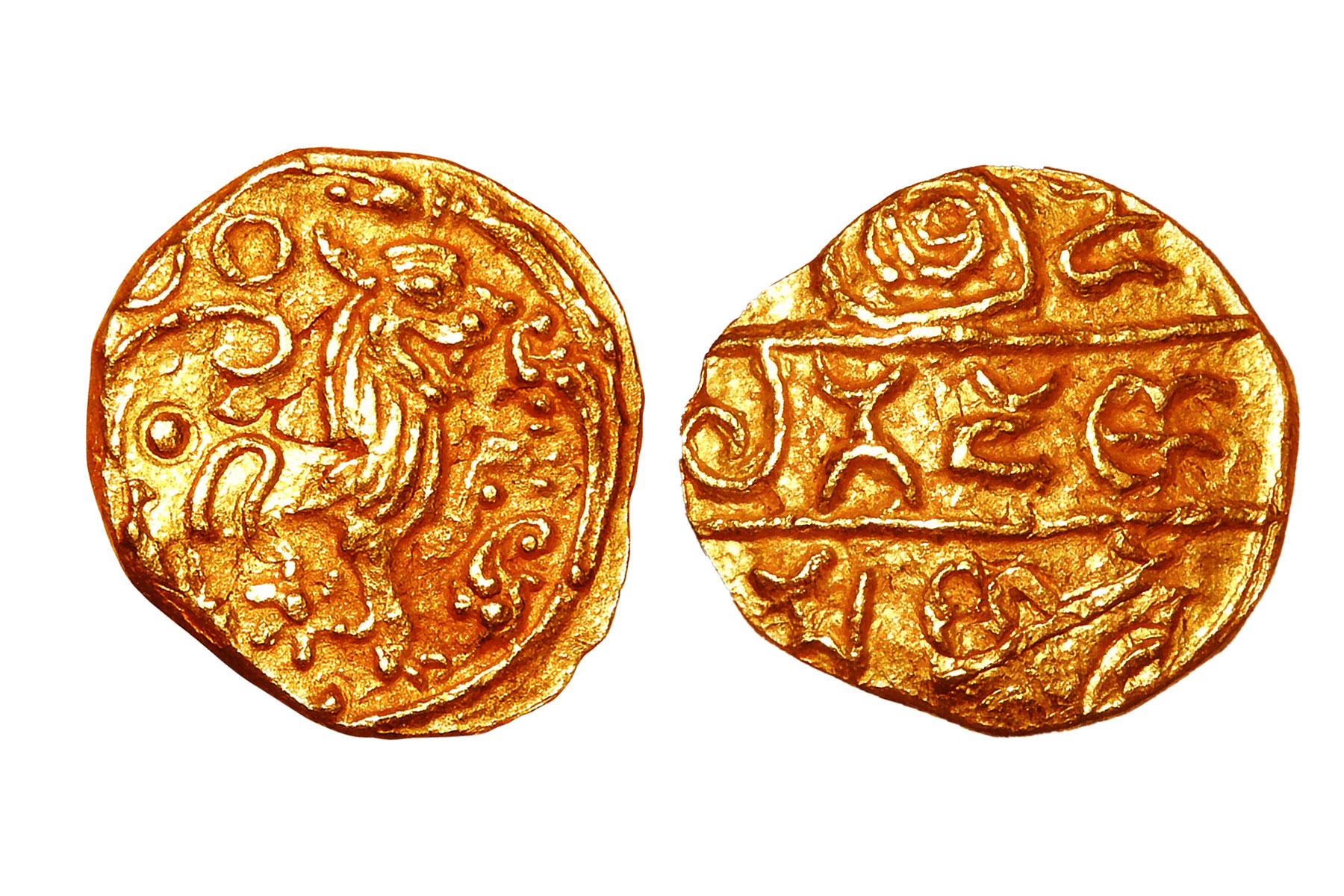
Hoysala Empire, Vishnu Vardhana (c. 1108-1152CE), Gold Pagoda, 3.90grms, Obv. A majestic lion standing to the right, foreleg raised in a poised stance, beneath the radiant Sun and Moon, all elegantly framed within an intricate floral border, Rev. Kannada legend divided in three lines Shri Maganga Konara, Overstruck on both sides on a Ganga Coin. Uncirculated, Very Rare. This remarkable gold pagoda belongs to the reign of Vishnuvardhana, one of the most celebrated rulers of the Hoysala Empire, known for territorial expansion, patronage of Vaishnavism, and the flourishing of temple architecture. The reverse legend “Shri Malagala Kesari” is extremely rare — only 3–4 specimens with this legend are known to exist. What makes this particular example especially significant is that it is overstruck on both sides over a Ganga coin, a feature not seen in any other recorded specimen. Such overstriking provides a unique insight into the transitional monetary practices of early 12th-century Karnataka and the interactions between the Hoysalas and their predecessors. This coin is therefore not only a numismatic rarity but also a critical historical artifact, offering valuable evidence for scholars studying coinage succession, dynastic authority, and the evolution of royal titulature in the Hoysala period.
430000

Lot No : 76
Auction No : 8
Shilaharas of Western Maharashtra(c. 1100CE), Double Fanam, 0.80grms, Obv. A majestic royal trident (Trishul) adorned with an intricate rosette, Rev. A striking Garuda, clutching a serpent and poised in dynamic dance. Although double fanams are extremely rare in Indian numismatic history, this coin represents one of the very few known issues. This exceptionally well-struck coin is usually uniface, but here the reverse displays a stunning Garuda, closely echoing the style of regional pagodas. The combination of extra-fine condition, deep obverse strike, and rare reverse detail makes this coin not only unique but extremely desirable for collectors and connoisseurs alike.
27000

Lot No : 77
Auction No : 8
Rashtrakuta Dynasty, Govinda IV(c. 930-935CE), Commemorative issue, Gold Heavy Gadyana, 4.30grms, Obv. Lion with a curled tail facing right holding a plough/ ankus, with a Conch between the legs, all within a dotted border, Rev. Hale Kannada Legend in two lines Sri Nanni Vedanga with a dotted border, A truly rare piece of history is coming up for sale after more than a decade, highlighting the extreme scarcity of these issues. This is the first recorded specimen featuring a conch between the legs, setting it apart from all known examples. Twenty years ago, Falcon Auction privately sold a specimen with a flower between the legs, while the piece offered about a decade back had no symbols in this position. The combination of historical significance, unmatched uniqueness, and symbolic detail makes this coin a must-have for serious collectors, representing a singular opportunity to own a piece that stands apart in Indian numismatic history. Govinda IV, grandson of the celebrated Amoghavarsha I, ruled during a period of considerable political instability. His authority was challenged by rival Rashtrakuta claimants, while the Paramaras and Western Chalukyas exerted pressure in the Deccan region. Despite these challenges, he maintained control over strategic territories and ensured the loyalty of key feudatories through alliances and administrative measures. His reign continued the Rashtrakuta tradition of temple construction and civic projects, including the building and maintenance of Hoysala-style temples and stepwells, as well as support for Brahmanical and Jain religious institutions, reflecting the dynasty’s cultural patronage. While his rule was short, he managed to consolidate power internally and preserve influence against rising regional powers. Govinda IV’s leadership reflects a combination of political acumen, architectural patronage, and strategic alliances, extending the legacy of his illustrious grandfather, Amoghavarsha I.
800000

Lot No : 78
Auction No : 8
Kadambas of Nagarakhanda (c. 400-600CE), Gold Fanam, 0.40grms, Obv. Garuda Standing facing right and a lamp on the right side, Rev. Kartikeya god front facing/ deity of Hari Hara king. deep strike and full figures visible on both sides, Very Rare. The Kadambas of Nagarakhanda, a regional branch of the ancient Kadamba dynasty in North Karnataka, maintained local governance amid larger powers like the Chalukyas and Rashtrakutas. They patronized Hindu temples, inscriptions, and arts, preserving Kadamba cultural traditions while shaping regional architecture and sustaining trade, religion, and administration in their territories.
13000

Lot No : 79
Auction No : 8
Vira Kerala (1102-1144 AD), Silver Unit, 2.38grms, obv. Nagari legend Shri Vira Keralasya with a crocodile in between the legend, rev. legend Shri Gandarankushasya with a spider/flower below (Mitch T&K 446). Very Fine, Rare Vīra Kerala, a Chera/Perumal ruler of Kerala, asserted authority over the Malabar coast while resisting pressure from the Later Cholas, whose influence lingered after earlier interventions. He maintained coastal autonomy against Pandya expansion from the south and managed rivalry with local chieftains (Naduvazhis) controlling ports and hinterlands. His epithet Śrī Gaṇḍarāṅkuśasya (“the formidable goad”) reflects a martial stance amid constant regional contestation rather than large-scale conquest
 WhatsApp